Balcony Pigeon Problems We Commonly See
Most customers call after the balcony has become difficult to use. The floor gets dirty every morning. Pigeons sit near the railing and fly inside when the door is open. Feathers collect near plants. Children or pets go near dirty corners. Sometimes the balcony smells bad even after cleaning because pigeons keep returning to the same place.
- Pigeon droppings on balcony floor, railing and tiles
- Birds entering through open balcony sides
- Nesting behind planters, AC pipes or corner areas
- Feathers and dry waste near balcony doors
- Birds sitting on glass railing or metal railing edges
- Balcony plants, chairs and clothes stands getting dirty
- Children or pets touching unhygienic balcony areas
- Repeated cleaning without solving the bird entry problem
Why Balcony Pigeon Nets Are Different From General Netting
A balcony is not just an empty opening. It is a daily-use space. People keep plants, chairs, washing stands, AC pipes, storage items and cleaning tools there. The balcony door must open freely. Air and light should remain comfortable. The view should not feel blocked. This is why balcony pigeon net installation needs a little more planning than simply tying a net across the front.
For apartment balcony pigeon nets, we check the railing, ceiling, side wall, floor edge, duct side and window access. For high-rise balcony pigeon net work, we also check height and exterior access. For glass railing balcony pigeon nets, fixing points must be selected carefully so the finish looks neat and the net holds properly. A clean layout makes the balcony safer, easier to maintain and more comfortable to use.
Need Help With Balcony Bird Netting?
Not sure whether your balcony needs full net coverage, side coverage or only one small gap closed? Send us a few photos on WhatsApp. We will check the opening, railing and bird entry points before suggesting the right option.
Where Balcony Pigeon Nets Can Be Installed
Balcony bird netting can be planned for many types of Hyderabad homes. The fixing method changes based on building design. A regular apartment balcony may have clear walls and ceiling points. A villa balcony may have a wider open side. A glass railing balcony may need careful alignment. A utility balcony may need access around pipes, washing machine area or AC service points.
Apartment Balconies
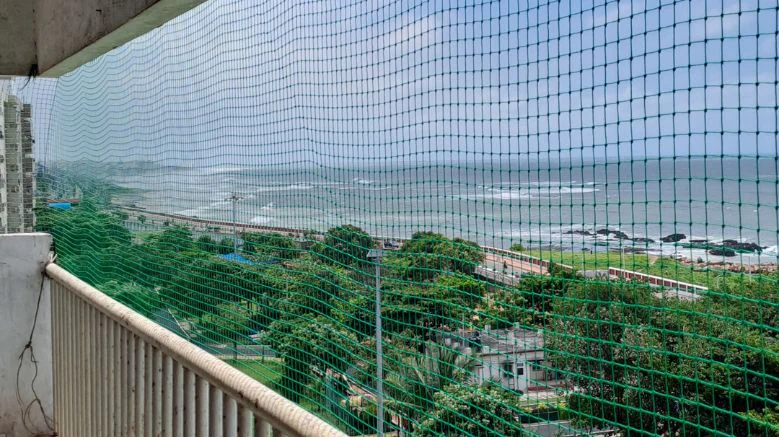
Balcony pigeon safety nets help reduce bird entry, droppings and nesting while keeping the space usable.
High-Rise Balconies
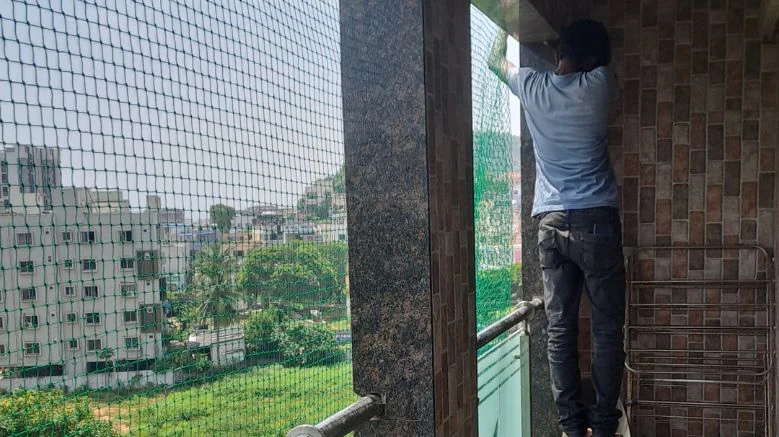
High-rise flats need careful measurement, strong edge fixing, proper tension and safe access planning.
Glass Railing Balconies
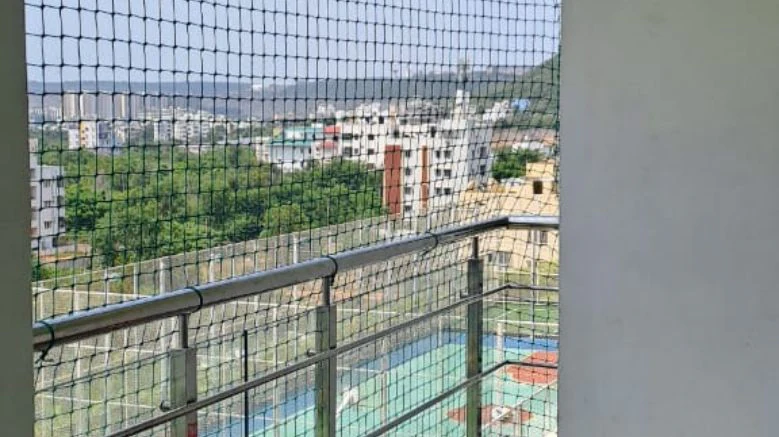
Glass railing balconies need neat fixing points so the net looks clean and does not disturb the balcony finish.
Utility Balconies
Utility balconies may need custom coverage around pipes, AC service areas, washing spaces and side gaps.
Balcony pigeon safety nets reduce bird entry, droppings, feathers and nesting inside the covered balcony area, but the result depends on correct coverage, material quality, fixing strength, edge sealing and regular checking. Nearby ledges may still need bird control spikes if pigeons keep sitting there.
What Happens During Balcony Installation
Before installing the net, we check the full balcony opening and the places pigeons use to enter. We decide whether the net should be fixed to the ceiling, side wall, railing, frame, hooks or anchors. We also check whether the net layout should leave space for plants, AC service, balcony cleaning, window access or clothes drying. A good balcony pigeon net should reduce bird entry without making the balcony uncomfortable.
Our Balcony Pigeon Net Installation Process
- Share balcony photos, approximate width and height, floor level and location.
- We check where pigeons enter, sit, nest or leave droppings.
- Balcony railing, ceiling, side wall, glass panel and access points are reviewed.
- Suitable net material, mesh size, border rope and fixing method are suggested.
- Price is confirmed based on measurement, material, height and site condition.
- Hooks, anchors and rope support are fixed carefully along planned edges.
- The net is tensioned, corner gaps are checked and balcony usability is reviewed.
Material and Mesh Options for Balcony Nets
The best balcony pigeon net depends on sunlight exposure, balcony height, railing type and how the balcony is used. HDPE balcony pigeon net, nylon balcony pigeon net, UV stabilized balcony bird net, transparent pigeon net balcony and anti bird net for balcony are common search terms, but the right choice should come from the site condition. A sun-facing balcony may need a different material suggestion than a shaded utility balcony.
| Material or part | Best use or reason |
|---|
| HDPE balcony pigeon net | Commonly used for regular apartment balconies and open balcony coverage. |
| Nylon balcony net | Useful for flexible coverage needs depending on fixing method and site condition. |
| UV-stabilized net | Better for balconies exposed to sunlight and outdoor weather. |
| Light color or transparent mesh | Can be considered where view, appearance and balcony brightness matter. |
| Border rope | Helps improve edge strength, tension and a cleaner balcony finish. |
| Hooks and anchors | Selected based on concrete, tile, metal, ceiling, side wall, frame or railing fixing. |
Pigeon Nets for Balcony vs Bird Spikes
Balcony pigeon nets and bird control spikes solve different problems. A net is better when pigeons enter the balcony through a wide opening. Spikes are better when birds only sit on a narrow ledge, parapet, AC top or railing edge. Many balconies need only netting. Some balconies need a net for the opening and bird spikes for nearby ledges where pigeons continue sitting above the balcony.
| Option | What it does | Best for |
|---|
| Balcony pigeon safety net | Creates a physical barrier across open balcony sides. | Apartment balconies, villa balconies, utility balconies and high-rise flats. |
| Bird control spikes | Discourage birds from landing on narrow surfaces. | Ledges, parapets, AC areas, beams and railing tops where birds sit. |
| Cleaning only | Removes current mess but does not stop pigeons from entering again. | Temporary cleanup before proper bird control work. |
| Net plus spikes | Controls both open entry and nearby landing points. | Balconies with bird entry plus ledge sitting above or beside the opening. |
Pigeon Net for Balcony Price in Hyderabad
Current installed guide: ₹10–₹25 per sq ft. The quote depends on measured balcony faces, net material and mesh, border rope, hooks, corner returns, AC or utility gaps, safe access and minimum job requirements. A pigeon-control net should not be represented as a child fall-protection system.
Pigeon net for balcony price is usually calculated after checking balcony width, height and fixing difficulty. A simple low-floor balcony is different from a high-rise balcony with exterior access. A clear concrete ceiling is different from a glass railing balcony or a balcony with many side gaps. Final pricing depends on net material, mesh size, support rope, hooks, anchors, number of open sides and total coverage.
If you are searching for pigeon net for balcony price, balcony bird net price, pigeon net installation near me or balcony net fixing service, compare more than just the amount. Ask whether the quote includes net material, hooks, anchors, border rope, proper tensioning and corner finish. A balcony net should look neat, stay firm and keep the space usable.
| Price factor | How it affects the quote |
|---|
| Balcony size | Wider and taller balconies need more net, rope and fixing time. |
| Height and access | High-rise balconies and difficult exterior access need more installation care. |
| Railing type | Glass, metal, concrete and frame designs need different fixing planning. |
| Net material | HDPE, nylon and UV-stabilized options can have different costs. |
| Coverage type | Side coverage, full front coverage, top-side coverage and utility gap closure affect price. |
| Support rope and edge work | Border rope, support cable, hooks and corner sealing can change the final quote. |
Want Exact Balcony Net Pricing?
Send balcony photos, approximate width and height, floor level and location. We will guide you on the suitable balcony net material, fixing method and price based on your site condition.
How We Keep the Balcony Practical After Netting
A balcony net should solve the pigeon problem without making the space feel closed. We check where the clothes stand may be placed, whether plants need sunlight, whether the AC unit needs service access, whether the balcony door opens freely and whether the railing area needs cleaning. These small details help the finished balcony feel natural after netting.
For some balconies, full front coverage is the right option. For others, side coverage is enough. If birds are entering through a duct-side gap, that small opening may need more attention than the full railing. If pigeons sit on a ledge above the balcony, bird spikes may be more useful there than extra netting. We explain this before starting so the work remains practical and cost-aware.
Who This Balcony Net Service Is For
Apartment residentsHigh-rise flat ownersVilla ownersGated communitiesTenantsProperty managersFamilies with childrenPet ownersPlant loversCommercial balcony areas
Common Balcony Situations We Handle
A family may call because pigeons sit on the balcony railing every morning. A high-rise flat owner may need netting without making the balcony look dark. A tenant may want a neat solution that does not disturb daily use. A villa owner may have a wider balcony where pigeons enter from the side. A resident with plants may need a layout that keeps light and watering access comfortable.
We also handle mixed cases. Sometimes pigeons enter the balcony and also sit on a nearby ledge. In that case, a balcony pigeon net may reduce entry while bird control spikes may be suggested for the ledge. Sometimes the issue is not the main balcony at all, but a small duct-side gap near the balcony. We check this before suggesting coverage.
Pigeon Safety Nets for Balcony Across Hyderabad
We install pigeon safety nets for balcony areas across Hyderabad, including Tellapur, Manikonda, Gachibowli, Kondapur, Madhapur, Hitech City, Kukatpally, Miyapur, Nizampet, Banjara Hills, Jubilee Hills, Nallagandla, Financial District, Kokapet, Attapur, LB Nagar, Uppal, Secunderabad and nearby areas. We explain the setup clearly so customers can understand the right balcony net type, coverage area and installation method before booking a site visit.
TellapurManikondaGachibowliKondapurMadhapurHitech CityKukatpallyMiyapurNizampetBanjara HillsJubilee HillsNallagandlaFinancial DistrictKokapetAttapurLB NagarUppalSecunderabad
Before You Ask for a Quote
To guide you quickly, share clear photos of the balcony from inside. Take one photo showing the full balcony opening, one close-up of the railing or glass panel, and one photo showing the ceiling or side wall where fixing may happen. Also share approximate width, height, floor level and location. If pigeons sit on a ledge above the balcony, include that photo too.
- Full balcony photo from inside
- Approximate width and height
- Railing type: glass, metal, concrete or grill
- Floor level and access details
- Issue type: droppings, nesting, feathers or bird entry
- Special needs: plants, AC service, clothes drying or cleaning access
Why Customers Call SJ Invisible Grill
We check the actual entry path
We look at where pigeons enter, sit and nest before suggesting full coverage, side coverage or ledge spikes.
We plan around daily balcony use
Plants, clothes stands, AC access, cleaning and door movement are considered before fixing the net.
We focus on neat fixing
The net should not hang loosely or leave gaps. We focus on hooks, rope support, corners and tension.
We explain material and price
Final pricing is explained after measurement, material choice, access checking and coverage planning.
We keep the balcony comfortable
We explain fixing points, net direction, visible lines and access before installation so you know how the balcony will look and function.
Maintenance and Service Notes
Check the balcony net occasionally after strong wind, heavy rain, cleaning work, painting, AC service or renovation activity. Remove collected dry leaves or debris early. Do not hang heavy items from the net. Avoid cutting or pulling the mesh. If any hook, rope or corner becomes loose, repair it early so pigeons do not start using a gap.
Warranty and Safety Note
Warranty or service support depends on net material, fixing method, balcony condition and usage. Damage caused by cutting, misuse, construction work, fire, external impact, forced pulling or third-party repair activity is not treated as normal use. Pigeon safety nets for balcony areas reduce bird entry and mess in the covered area, but correct coverage and regular checking are important for the best result.
Related Bird Control Services
Questions Customers Ask
Balcony Pigeon Safety Nets FAQ
Are pigeon safety nets suitable for apartment balconies?
Yes. Pigeon safety nets are commonly used for apartment balconies where birds enter from open sides, sit on railings or leave droppings near the door and floor.
Will a balcony pigeon net block air and light?
A properly selected balcony pigeon net allows airflow and light while creating a physical barrier against bird entry. The final look depends on mesh color, tension and fixing line.
Can you install pigeon nets on glass railing balconies?
Yes, many glass railing balconies can be netted after checking safe fixing points. We review ceiling, side wall, frame and railing conditions before suggesting the fixing method.
How is balcony pigeon net price calculated?
Price depends on balcony width, height, open sides, material, hooks, anchors, border rope, height access and whether the balcony needs side or full coverage.
What material is best for balcony pigeon safety nets?
HDPE, nylon and UV-stabilized nets are commonly used. The best option depends on sunlight exposure, balcony height, fixing points, mesh need and expected durability.
Can balcony pigeon nets be installed without disturbing plants or clothes drying?
In most cases, yes. We check how the balcony is used and plan the net layout so daily use remains practical after installation.
Do you install pigeon safety nets for balcony near me in Hyderabad?
Yes. We install balcony pigeon safety nets across Hyderabad and nearby areas based on site access, measurement and schedule.
Book Pigeon Safety Nets for Balcony in Hyderabad
Make your balcony cleaner and easier to use with a neatly installed pigeon safety net. Call or WhatsApp SJ Invisible Grill for balcony inspection, material suggestion and price estimate.